
 US Dollars
Motorcycle Audio Water Resistance and IP Ratings: What Riders Need to Know
Last Updated: Oct 13th 2026
Motorcycle audio electronics should be treated as water-resistant, not waterproof. An IP rating identifies the type of ingress resistance tested for a particular component, but it should not be interpreted as unlimited protection from water.
Understanding those limits can help protect motorcycle audio equipment during riding and cleaning.
What Is the Difference Between Water-Resistant and Waterproof?
Water-resistant electronics are designed to tolerate a specified level of moisture exposure. The term “waterproof” can imply broader protection than a component’s tested or specified limits actually support.
For motorcycle audio equipment, water resistance depends on the individual component and its tested or specified limits. An IP rating helps identify those limits.
What Does “Weatherproof” Mean for Motorcycle Speakers?
Weatherproof motorcycle speakers are designed to withstand outdoor conditions they may encounter during normal riding and use. Depending on the speaker, this can include resistance to moisture, rain, UV exposure, and other environmental conditions.
KICKER is one example of a weatherproof speaker option. Its Powersports speakers use materials designed to resist water, fog, UV exposure, and other outdoor elements.
Weatherproof does not mean a speaker is protected against every type, pressure, or duration of water exposure, and it should not be interpreted as meaning the speaker is submersible.
Weatherproof also does not indicate a specific IP rating . If a speaker has an IP rating, that rating is a separate specification based on defined ingress-protection testing.
What Is an IP Rating?
An IP code, commonly called an IP or ingress-protection rating, describes the degree of protection an electrical enclosure provides against access, solid foreign objects, and water.
A typical IP rating begins with “IP” followed by two characters. In a designation such as IP65:
- The first numeral indicates protection against access to hazardous parts and solid foreign objects.
- The second numeral indicates protection against water ingress.
If an “X” replaces one of the numerals, that portion of the rating is not specified by the designation. For example, IPX6 identifies a water-protection classification without specifying a solid-particle rating.
For motorcycle audio equipment, the second character is particularly relevant because it identifies the component’s tested resistance to water exposure.
|
Example Rating |
General Water-Protection Meaning |
|
IPX4 |
Protection against splashing water |
|
IPX5 |
Protection against water jets |
|
IPX6 |
Protection against powerful water jets |
|
IPX7 |
Protection against temporary immersion under specified test conditions |
|
IPX8 |
Protection against continuous immersion under specified conditions |
Water-protection ratings are cumulative through IPX6, but IPX7 and IPX8 are immersion classifications. An IPX7 or IPX8 rating alone does not automatically establish protection against the water-jet conditions covered by IPX5 or IPX6.
Does an IP Rating Apply to the Entire Motorcycle Audio System?
No. An IP rating applies only to the component or enclosure to which the rating is assigned.
An audio-equipped batwing fairing may contain several separate components, including speakers, a head unit or media receiver, an amplifier, wiring, connectors, and other electrical connections. Each can have its own construction and level of environmental protection.
A published IP rating for a speaker, for example, does not automatically apply to the head unit, amplifier, wiring, or complete fairing installation.
What Water Exposure Should Motorcycle Audio Equipment Avoid?
Our motorcycle audio equipment should not be subjected to a direct deluge of water. Examples include:
- direct exposure to a heavy downpour
- a pressure washer aimed at the speakers, head unit, or other electronics
- a concentrated stream from a garden hose
- prolonged soaking around electronic components
Pressure, volume, direction, and duration can affect water exposure. Concentrated or pressurized streams can force water toward seams, controls, openings, connectors, and other vulnerable areas.
How Should You Wash a Motorcycle With an Audio-Equipped Batwing Fairing?
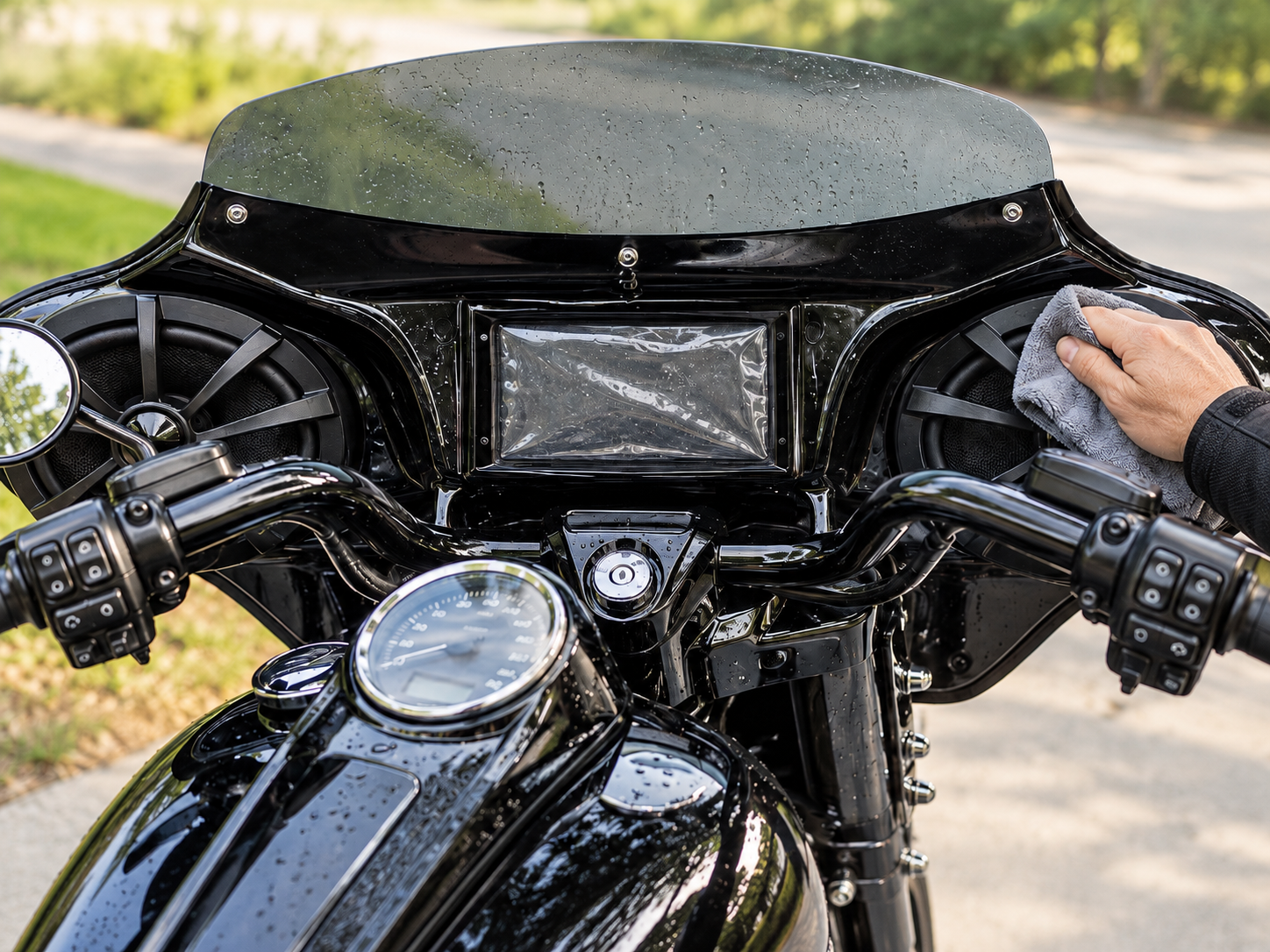
Use controlled cleaning methods around the audio equipment rather than saturating the electronics. When practical, a damp cloth gives you better control around speakers, head units, controls, and other sensitive areas.
If your motorcycle is equipped with our BOSS unit, use the supplied protective cover over the head unit when washing the motorcycle. The cover provides an additional barrier during cleaning, but it should not be treated as making the head unit waterproof.